
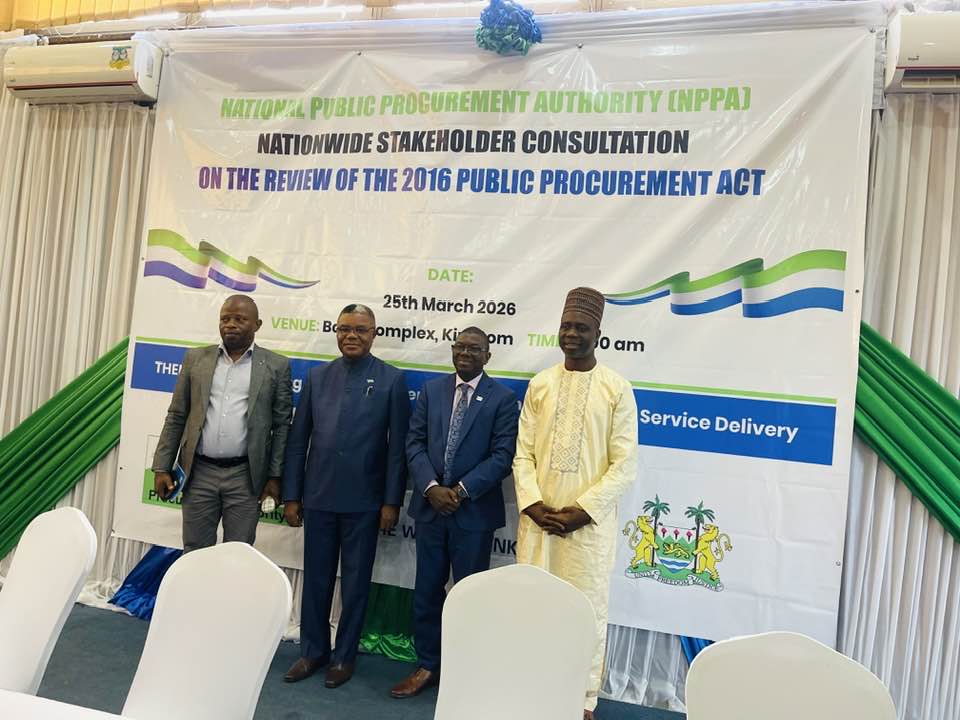
Freetown, March 25, 2026. Government officials, private sector representatives, civil society organizations, and procurement professionals convened at the Bank Complex, Kingtom, Freetown, on Wednesday, March 25, 2026, for a high-level consultation on the review of the Public Procurement Act, 2016. The engagement forms part of ongoing efforts to strengthen Sierra Leone’s public procurement system and enhance the effective management of public resources.
Welcoming participants, the Chief Executive Officer of the National Public Procurement Authority (NPPA), Mr. Fodie J. Konneh, described the consultation as both timely and critical within the broader national reform agenda. He underscored the central role of public procurement in translating government resources into tangible services that directly impact citizens’ lives.
“Whether in the delivery of roads, schools, hospitals, medicines, energy, or other public services, procurement plays a central role in national development,” he stated. He further emphasized that public procurement must be viewed not merely as an administrative function, but as a strategic governance tool that promotes competition, value for money, fairness, and public confidence. He cautioned that weak procurement systems can lead to inefficiencies, delays, poor service delivery, and misuse of public funds.
Mr. Konneh also highlighted that sustainable procurement reform requires a collective effort, calling on all stakeholders—including government institutions, oversight bodies, contractors, suppliers, civil society, and development partners—to actively contribute to shaping a more robust system.
In his remarks, the Chief Economist at the Ministry of Finance, Mr. Alimamy Bangura, stressed the need to modernize Sierra Leone’s procurement framework to align with evolving technological advancements, governance standards, and public expectations. He noted that while the country’s procurement framework dates back to 2004, it does not fully reflect the realities of today’s digital environment.
He identified electronic procurement (e-procurement) as a key reform priority, explaining that the introduction of digital systems would enable online tender advertisement, electronic bid submissions, digital record-keeping, contract management, and improved financial reporting. According to him, such innovations will significantly enhance transparency, reduce delays, minimize human interference, and improve efficiency across public institutions.
Mr. Bangura further emphasized that while legal reforms are essential, they must be complemented by strong institutions, skilled procurement professionals, effective oversight mechanisms, and robust accountability systems to achieve meaningful results.
Also addressing participants, Dr. Emmanuel A. Gaima, Principal Executive Adviser to the President on the Public Service and Head of Public Service Reform Unit (PSRU), in his keynote speech highlighted the strategic importance of procurement in governance and national development. Reflecting on Sierra Leone’s reform journey, he noted that procurement reforms were originally designed to promote transparency, fairness, and efficiency in public financial management.
Dr. Gaima described procurement as the critical link between government policy and service delivery, noting that it is through procurement that infrastructure is built, medicines are supplied, and essential services are delivered. He stressed that an effective procurement system is fundamental to state credibility, fiscal discipline, and public trust.
He further urged that the review of the Act should go beyond procedural adjustments to focus on outcomes—ensuring that the system delivers value for money, promotes fair competition, reduces delays, safeguards public resources, and strengthens confidence in public institutions.
Participants at the consultation unanimously agreed that procurement reform must extend beyond legislative changes to include the development of a transparent, efficient, and accountable system supported by digital innovation, institutional capacity, and effective oversight.
The consultation held in Freetown marks the culmination of a nationwide stakeholder engagement process on the review of the Public Procurement Act, 2016. Earlier consultations were successfully conducted across the regions, including Kenema for the Eastern Region, Bo for the Southern Region, Makeni for the Northern Region, and Port Loko for the North-West Region.
The NPPA confirmed that all stakeholder inputs gathered during these consultations will be carefully reviewed and incorporated into the reform process. The next phase will involve a detailed technical review with a consultant, followed by submission to the Law Officers’ Department for legal drafting and alignment.
Subsequently, a national validation exercise will be convened to bring stakeholders together once again to review and take ownership of the proposed reforms. The finalized draft will then be submitted to Cabinet for approval before being presented to Parliament for enactment into law.
The ongoing reform process is expected to significantly modernize Sierra Leone’s public procurement system, ensuring that public resources are utilized efficiently and transparently to support national development and improve service delivery for all citizens.
For more information, please visit the NPPA website: www.nppa.gov.sl
