
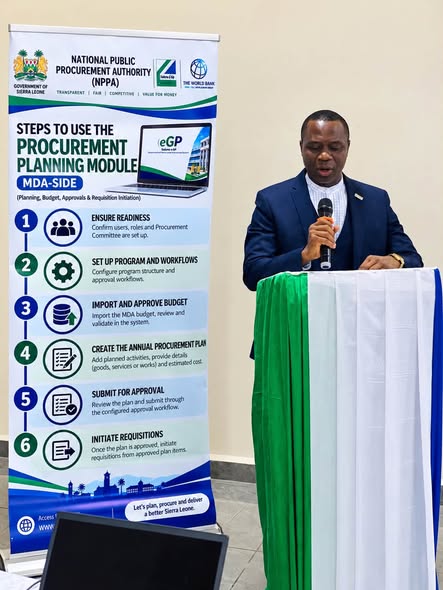
Freetown, 15 October 2026 — The National Public Procurement Authority (NPPA) has intensified preparations for the nationwide implementation of Sierra Leone’s Electronic Government Procurement (e-GP) System, bringing together key government officials and technical personnel for a two-day stakeholder engagement workshop and refresher training at the New Brookfields Hotel in Freetown.
The workshop, which commenced on Wednesday, 14 October 2026, forms part of preparations for the formal rollout of the e-GP System, a major public sector reform designed to modernize procurement, strengthen transparency and accountability, improve efficiency and expand access to government contracting opportunities.
Participants included Vote Controllers, Heads of Procurement, Heads of Finance and Heads of Information Technology from participating Ministries, Departments and Agencies (MDAs), alongside NPPA management, technical personnel and other stakeholders.
NPPA CEO: e-GP is a governance reform:
Delivering the keynote address, NPPA Chief Executive Officer, Mr Fodie J. Konneh, MCIPS, underscored the importance of public procurement to national development. “Public procurement is the engine room of government spending,” he stated, noting that effective procurement management directly influences the delivery of schools, hospitals, roads, energy and other essential services. He explained that moving from paper-based procedures to electronic procurement would address challenges associated with slow processes, high administrative costs, missing files, restricted competition and weak audit trails.
The CEO declared: “e-GP is not merely an IT project. It is a governance reform.” He said the system would make procurement faster, cheaper and more transparent, expand opportunities for suppliers, including small businesses, and provide citizens, auditors and oversight institutions with a clearer record of public expenditure.
Tracing the reform’s milestones, CEO Konneh recalled the launch of the e-GP initiative in December 2023 and the introduction of electronic procurement documents in December 2024. In January 2026, the Supplier Registration Module went live, making the portal the exclusive channel for supplier, contractor and consultant registration in accordance with Regulation 10(2) of the Public Procurement Regulations, 2020. He also highlighted progress in customizing the system to Sierra Leone’s procurement environment and expanding the pilot from seven to fifteen MDAs.
AGBSD Project reaffirms commitment to digital reform:
Speaking on the Accountable Governance for Basic Service Delivery Project (AGBSDP), Project Coordinator Mr. Adams Tommy highlighted the project’s contribution to public financial management reforms, institutional strengthening and improved service delivery.
The US$40 million project, which became effective in January 2022 and is scheduled to end in July 2027, supports improved resource management, transparency and accountability across government institutions. Its interventions include public financial management improvements across eleven MDAs and twenty-two Local Councils, alongside support for local development subprojects. Mr Tommy reaffirmed the commitment of the Ministry of Finance and the World Bank to completing the reforms supported by the project.
“The leadership of the Ministry of Finance, which chairs the Project Steering Committee, and the World Bank team remain committed to ensuring that all key reforms implemented by the project are completed,” he stated.
He acknowledged the contributions of the Ministry of Finance, the World Bank, the Project Management Unit and the NPPA implementation team, particularly the e-GP technical team. Calling for institutional ownership, he urged MDAs to support the transition, stating: “We count on leadership of the MDAs to wholeheartedly accept and see through the smooth implementation of this laudable venture.” His remarks underscored the importance of collaboration among government institutions, development partners and implementation teams in ensuring that e-GP delivers greater transparency, accountability and efficiency in public expenditure management.
Change leadership and institutional readiness:
A central focus of the workshop was preparing institutions to operate effectively within the electronic procurement environment. Chief Konneh stressed that successful implementation would depend on coordinated leadership, staff readiness and adequate technical support.
Addressing Vote Controllers, he stated: “Your commitment will determine whether e-GP is embraced or resisted in your institution.” He outlined the responsibilities of the four key officers: Vote Controllers would provide leadership and accountability; Heads of Procurement would manage procurement processes; Heads of Finance would ensure alignment with approved budgets and payments; and Heads of IT would maintain equipment, connectivity and user support.
The CEO of AH Consulting also highlighted the critical role of change management and change leadership in digital transformation. He emphasized that resistance to change was foreseeable when transitioning from traditional paper-based processes to electronic procurement.
The discussions underscored that strong leadership, active staff participation and sustained stakeholder engagement were essential to securing institutional acceptance, encouraging behavioral change and ensuring consistent use of the Salone e-GP System.
Chief Konneh urged participants to raise concerns and identify solutions before implementation, stressing: “Every challenge you raise here is one we can solve before go-live, rather than after.” He called on institutions to assign system user roles to designated officers, provide adequate equipment and internet connectivity, share knowledge with colleagues and report technical problems promptly. The NPPA, he assured participants, would provide continued assistance through its e-GP team, helpdesk and regional offices in Bo, Kenema and Makeni.
Advancing Sierra Leone’s digital transformation agenda:
The e-GP initiative represents a significant step in the digital transformation of Sierra Leone’s governance processes. By moving procurement activities to an electronic platform, the reform seeks to improve how government plans, manages and accounts for public expenditure. It complements the wider digitalization and public service modernization agenda of President Dr. Julius Maada Bio’s administration, particularly efforts to improve government efficiency, strengthen accountability and enhance public service delivery. Beyond replacing paper-based procedures, e-GP provides a foundation for stronger coordination between procurement, budgeting and financial management. Its success will depend on institutions consistently using the platform and embracing the operational changes it introduces.
Collective responsibility for successful implementation:
As the first day concluded, the message was clear: successful digital transformation requires more than technology. It demands institutional leadership, staff readiness, stakeholder cooperation and sustained technical support. Mr Konneh thanked the Ministry of Finance, the World Bank and the AGBSD Project for their continued support, while commending the system developers, facilitators and NPPA’s Directorate of ICT and e-GP for their dedication.
The workshop continues on 15 October 2026, with further engagement intended to strengthen participants’ understanding of the system and consolidate preparations for its rollout. As Sierra Leone moves closer to the full implementation of e-GP, the reform signals an important shift towards a more transparent, efficient and accountable public procurement system, ensuring that public resources are managed more effectively in support of national development.
