
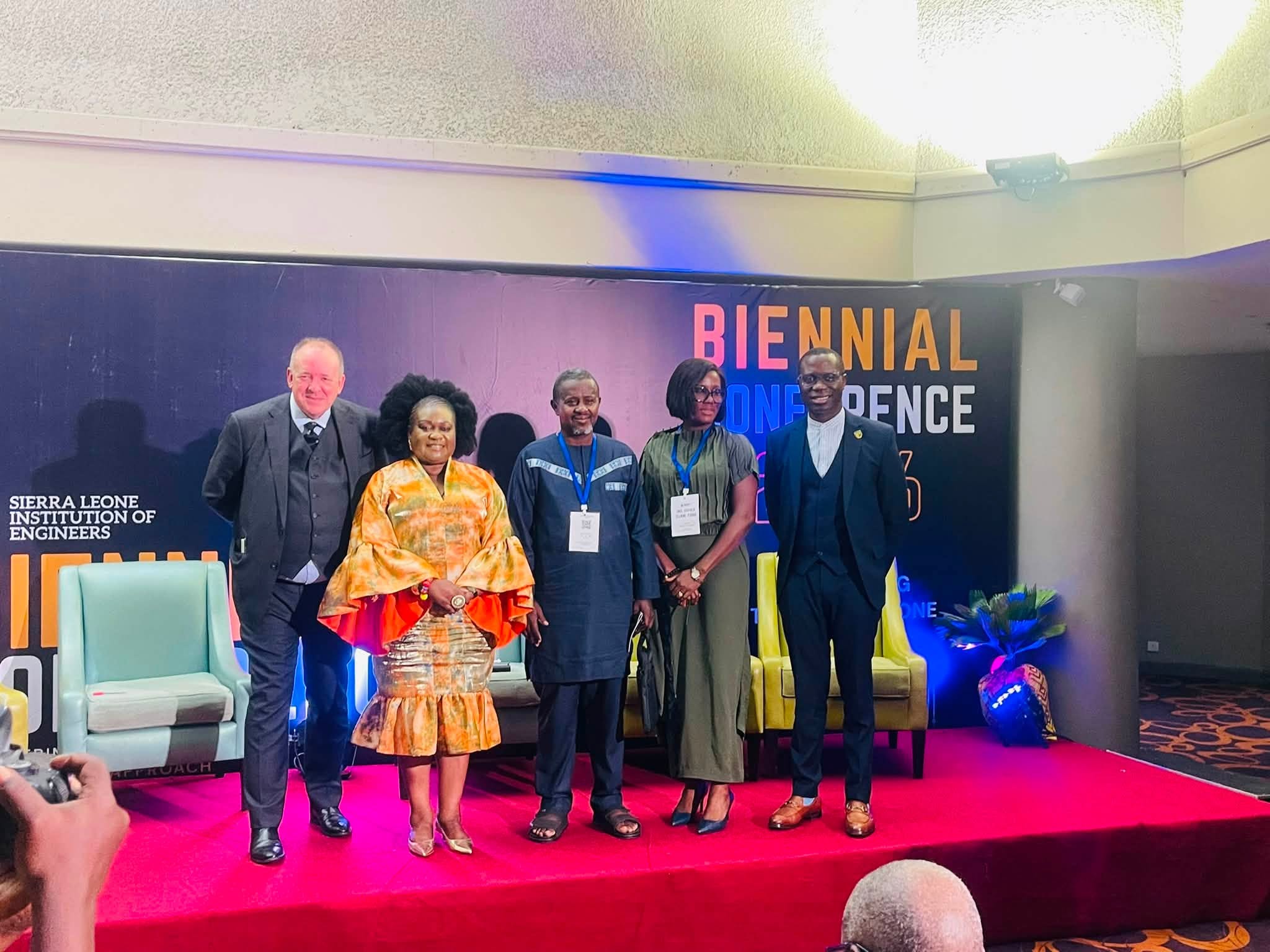
Freetown, Sierra Leone, 17 June 2026 – Chief Executive Officer of the National Public Procurement Authority (NPPA), Chief Fodie J. Konneh, has called for stronger engineering leadership, enhanced professional standards, and greater inclusion of engineers in national decision-making as key drivers of sustainable development.
Chief Konneh made the call during a panel discussion on Engineering Leadership, Policy, Standards and Capacity Development for Nation-Building at the 2026 Biennial Conference of the Sierra Leone Institution of Engineers (SLIE), held at the Radisson Blu Mammy Yoko Hotel, Freetown under the theme “Engineering the Sierra Leone We Desire: A Sustainable Approach.”
The session, hosted by Ing. Trudy Morgan FSLIE, President of the Commonwealth Engineers’ Council, featured panelists from Sierra Leone, Ghana, the African Development Bank, and the private sector.
Chief Konneh emphasized that engineers should play a greater role not only in project implementation but also in policy formulation, planning, regulation, monitoring, and oversight. He urged the Sierra Leone Institution of Engineers to remain apolitical and serve as an independent professional body that provides objective and evidence-based advice on national infrastructure projects and development policies.
Reflecting on Sierra Leone’s infrastructure history, he challenged participants to compare the quality of older infrastructure with many modern projects, noting that numerous roads, bridges, and public buildings constructed decades ago remain functional today. He called for a renewed commitment to quality standards and long-term infrastructure sustainability.
He also highlighted the country’s weak maintenance culture, stressing that infrastructure investments must be accompanied by structured maintenance systems, dedicated funding, and specialized technical expertise. According to him, maintaining infrastructure is just as important as constructing it.
Addressing capacity gaps, Chief Konneh pointed to the shortage of specialized engineers, particularly lift engineers, noting that recurring elevator failures in many facilities demonstrate the need for greater investment in niche engineering disciplines. He further emphasized the strong connection between engineering and urban planning, arguing that sustainable development requires close collaboration among engineers, planners, architects, environmental specialists, and policymakers.
Chief Konneh referenced the Public Finance Management and Infrastructure Coordination Platform (PFMICP), an initiative he established to encourage collaboration among professionals involved in infrastructure delivery and public financial management. He encouraged members to be proactive in identifying and addressing infrastructure challenges.
On human capital development, he called on educational institutions and professional bodies to expose students to the wide range of engineering careers available beyond the traditional civil, mechanical, and electrical disciplines. He noted that Sierra Leone requires specialists in emerging fields such as renewable energy, telecommunications, environmental, software, biomedical, transportation, and geotechnical engineering to support modernization and economic growth.
Linking engineering leadership to governance reforms, Chief Konneh highlighted key initiatives being implemented by the NPPA to improve public investment outcomes. He referenced the recently completed Methodology for Assessing Procurement Systems (MAPS), which assessed Sierra Leone’s procurement system and identified critical reform areas.
He also highlighted the introduction of the Electronic Government Procurement (e-GP) System, describing it as a transformative reform that reduces human discretion, improves transparency and accountability, and strengthens the efficiency of public procurement processes.
Chief Konneh further noted that Sierra Leone is increasingly adopting Combined Weighted Evaluation methods in public procurement, moving away from the traditional practice of awarding contracts solely on the basis of the lowest price. Under the new approach, contracts are awarded to the Most Advantageous Bid, taking into account both technical quality and financial value to ensure better project outcomes and greater value for money.
Concluding his remarks, Chief Konneh urged engineers to view themselves as strategic leaders and nation-builders. He stressed that stronger engineering governance, professional independence, specialized skills development, innovation, maintenance culture, and collaboration among engineers, procurement professionals, policymakers, and oversight institutions are essential for building resilient infrastructure and achieving sustainable national development.
For more on this and any other issues relating to the activities of the NPPA, please contact us: info@nppa.gov.sl
